
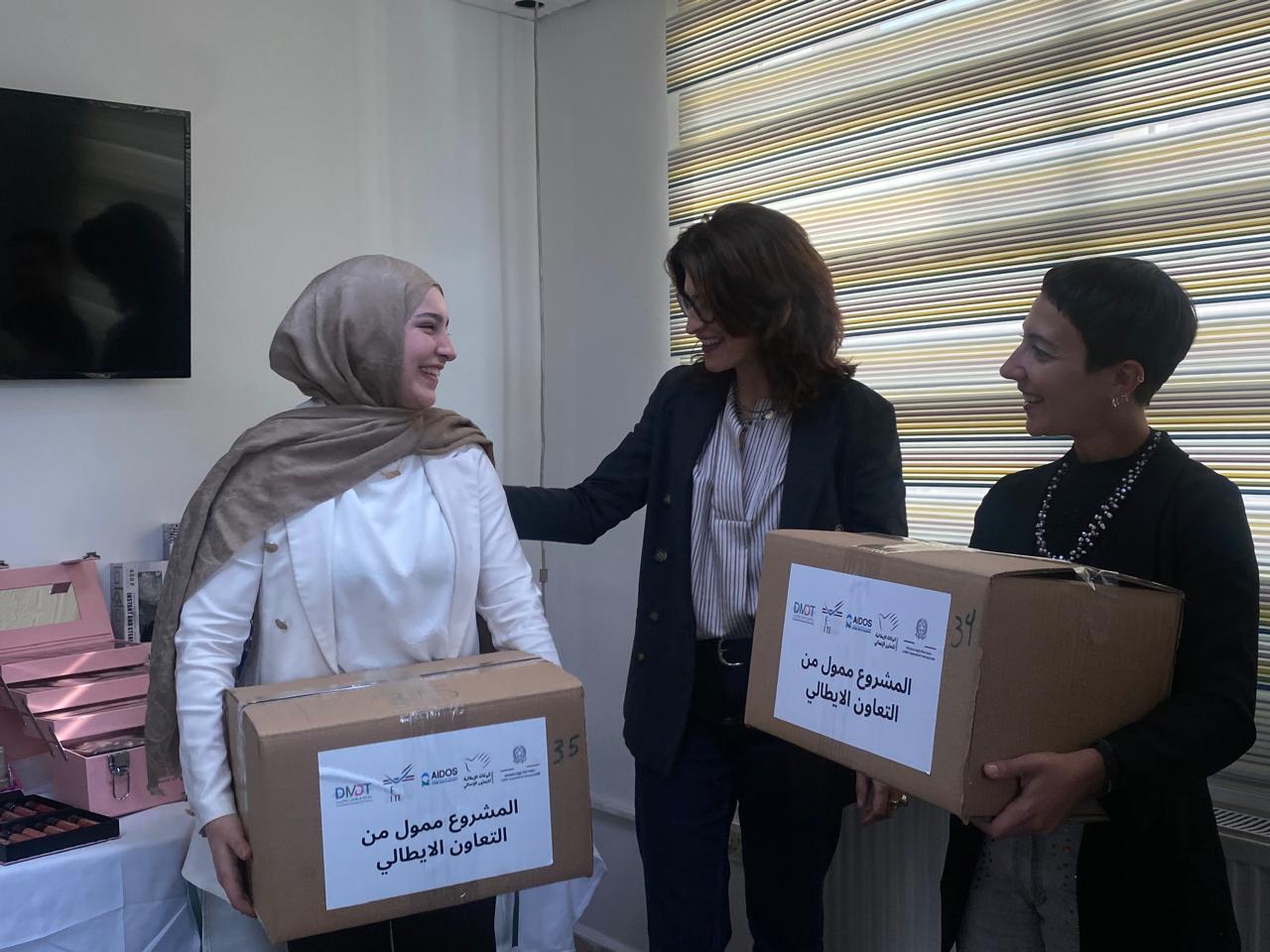
“The course gave me the opportunity to challenge myself and acquire new and concrete skills, most importantly it gave me new self-confidence. It is important for a woman to see that she can do it and be independent, to prove it to herself and not just to society.” Aminah, a fictitious name, just picked up her diploma certifying her participation in the professional tailoring course, a title recognized not only in Jordan but internationally, thus expendable everywhere. Together with other women, we met Aminah last month during our mission to Jordan for the second phase of the project No woman left behind, to counter gender-based violence and its intersection with disability. Many women, including several Syrian refugees living in Jordan, have already completed the proposed trainings. At the end of the project there will be 165 participants in courses on economic empowerment, a key factor in countering gender-based violence: entering the labor market means in fact gaining financial independence and decision-making power over one’s life, helping to facilitate the exit from violence.
During the mission, we were in Amman and Irbid, where we met with our partners to talk about what we have accomplished so far and to imagine new activities together, which will also address increasingly pressing challenges, such as the climate crisis. Funded by the Italian Agency for Development Cooperation, the project has Vento di Terra Onlus, Durrat al Manal for Development and Training and Arab Women Organization as partners. Over the years we have built a wide network that allows us to act and build alliances, composed of feminist collectives, civil society organizations, and institutions, as international organizations active in the country. It is part of the Aidos’ approach to dialogue and collaborate with all these actors, recognizing the complexity of the phenomena our projects aim to address. Only in this way was it possible to develop, during the first phase of No woman left behind, guidelines on gender-based violence and disability, which now form the basis of the training of various professional figures, conducted in collaboration with UNFPA, and whose adoption at the national level is among the objectives of this second phase. This has also enabled, in the Irbid shelter for women survivors of gender-based violence, the necessary work to make these facilities also accessible to women with disabilities.
Keeping the different plans together means for Aidos organizing a course on economic empowerment, and giving a start-up kit with materials and equipment to materialize the start-up of a professional activity. But not only: among the materials given to the participants were in fact a dignity kit with products for personal care and hygiene and a voucher to access the social and health services of a clinic of excellence in Amman. In addition, participation in awareness sessions on sexual and reproductive health and rights and gender-based violence. So what is the nexus between professional trainings and these kinds of services? Getting a mammogram or other exams means being able to prevent diseases, staying healthy and independent for longer, while having tampons means being able to leave home to work even when you are menstruating. Access to sexual and reproductive health and to health is a prerequisite for embarking on a stable career path: economic empowerment and health are not on separate tracks, but rather complement each other by paving the way for full self-determination.